About the project
Medieval Eastern Orthodox calendars of saints are extremely diverse in their commemorations for most calendar days of the year because the Eastern Orthodox Church had no canonization or beatification process. Thus local monasteries and priests were free to assign saints, including locally venerated saints, to whichever calendar date they deemed appropriate. The lack of consistency among calendars, the sheer number of calendars, and the fact that most medieval Slavic calendars of saints are unpublished have made it notoriously difficult to access and organize the data from such a large corpus, and to identify many of the saints who appear in calendars on more minor feast days. It is for this reason that a typology of medieval Slavic calendar traditions has not yet been developed.
The open-access database and search program at this site are intended to ameliorate this situation by providing a large corpus of medieval Slavic and Greek calendars of saints that can be searched according to specific attributes of the manuscripts themselves and the commemorations they contain. The goal is to provide scholars with a large but manageable corpus of data for comparative study of calendar traditions, determination of the relationships between and among calendars, and analysis of any individual calendar.
The files in the corpus consist of the saints entries, or commemorations, from medieval calendars; that is, they do not contain the entire calendar text, pericope listings, services, or other liturgical instructions. Where the original text of a calendar’s saints entries is available, it has been included in the file. The Church Slavonic and Greek texts are rendered in Old Cyrillic and polyphonic Greek fonts and are readable on the Internet.
The electronic calendar collation is a long-term project, and the corpus of calendars and search program is only at a beginning stage. At present the on-line corpus contains only a small number of the over 700 medieval Slavic and Greek calendars that I hope to include in it eventually. Among the calendars still to be added are over 120 manuscripts that I copied saints’ entries from by hand in archives in Bulgaria, Russia, and England; manuscripts from microfilm collections at the Hilandar Research Library at The Ohio State University, the Bulgarian Academy of Sciences Central Library, and the manuscript division of the Cyril and Methodius National Library in Sofia; and medieval Roman martyrologies. A long-term goal is the inclusion of calendars of saints from the Coptic, Syrian, Georgian, Armenian, and other traditions.
All users are invited to contribute to the on-line corpus other medieval Eastern Orthodox calendars from any tradition. If you would like to participate in this project, please contact Professor Cynthia Vakareliyska at the Department of Linguistics, University of Oregon (vakarel@uoregon.edu) to receive instructions on how to text-encode the calendars.
If you find any typographical errors or errors in the identification of saints in the files, or if you can identify any saints in the files that I have not yet been able to identify, please contact me at vakarel@uoregon.edu.
About the reading interface
The reading interface for a manuscript looks as follows:
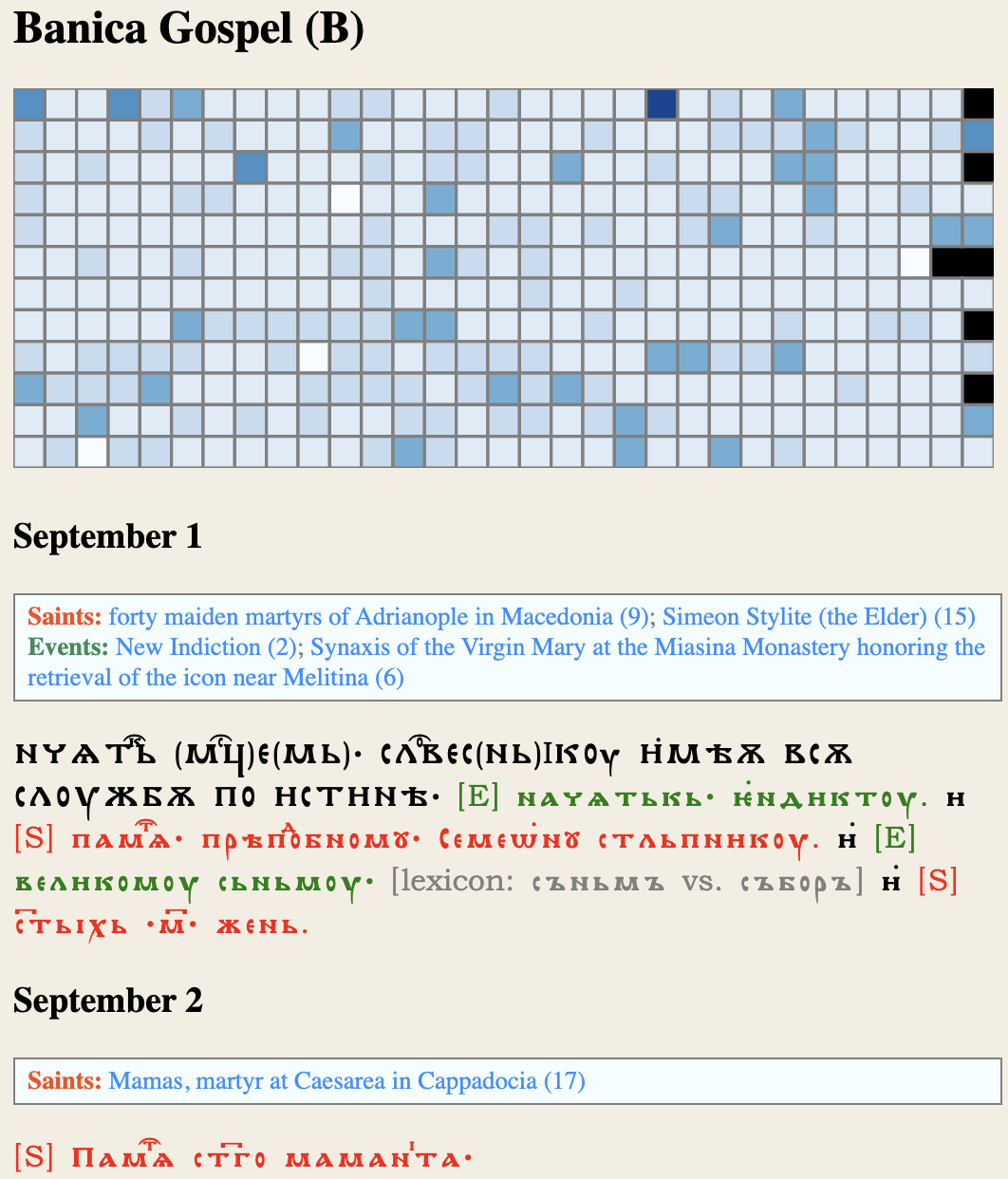
Hover over the information icon (ⓘ) after the manuscript name to expose manuscript metadata.
The grid at the top corresponds to the liturgical calendar, where rows are months (starting with September) and columns are dates in the month (1 through 31). Black squares are gaps in the calendar (e.g., there is no September 31); white squares have no commemorations on that date in that menology; and the darkness of blue squares increases with the number of commemorations. For example, in the grid above, September 21, the darkest blue square, has the most commemorations of any date in this particular menology. Hover over a square to see the date and the number of commemorations. Click on a square to scroll to that portion of the calendar.
The white box below each date lists the standardized names of each saint, saint set, and event commemorated on that date in that menology, followed, in parentheses, by the number of times that commemoration appears in the entire corpus under any date. In the example above, Simeon Stylite (the Elder) appears fifteen times in the corpus. Clicking on a name in the white box returns a list of those appearances, e.g.:
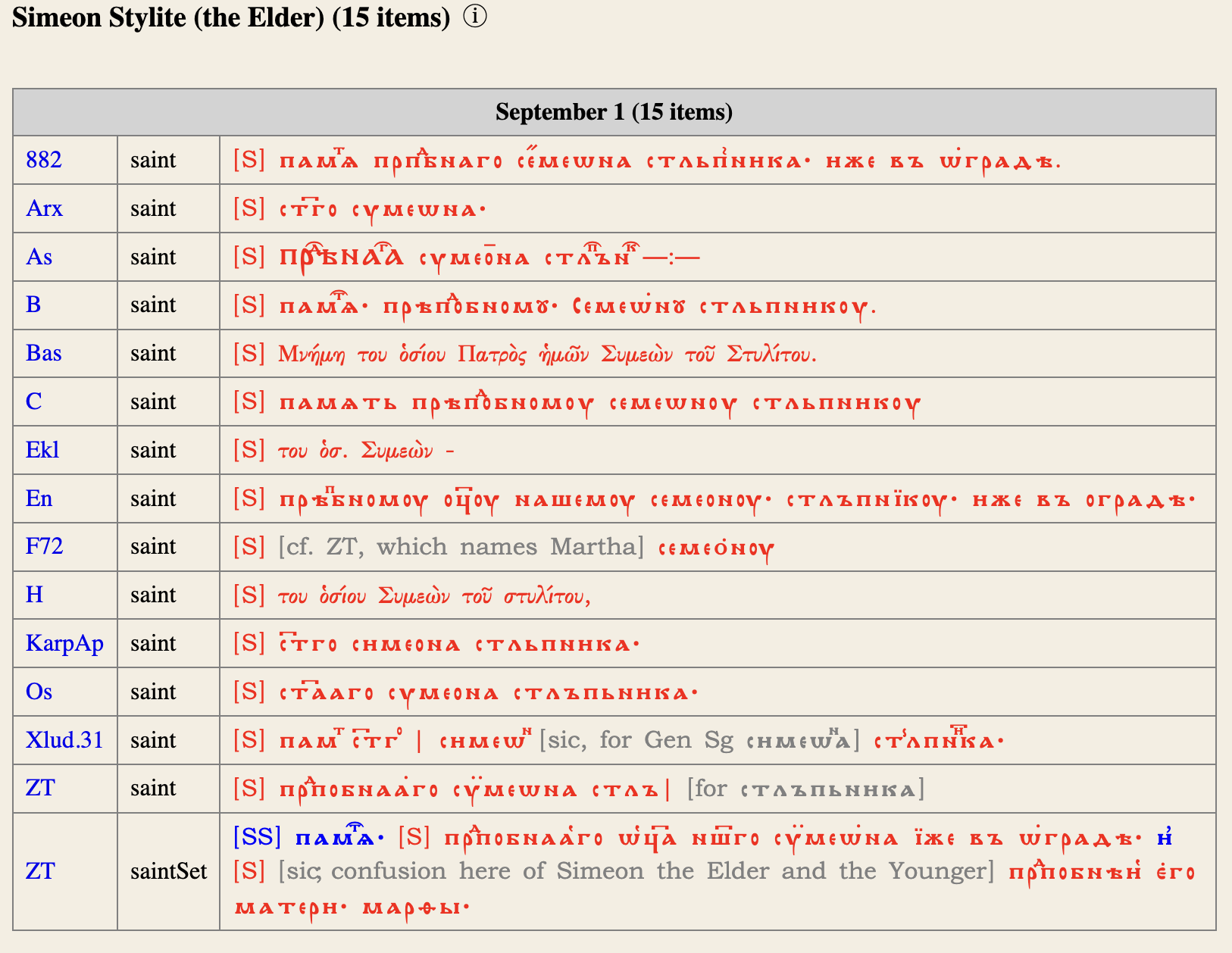
In this list, clicking on the manuscript identifier in the leftmost column navigates to the entry in the reading view of that particular calendar. Hover over the entry in the second column to expose the standardized name of the saint, saint set, or event. This name will not always match the name at the top of the view. For example, in the listing obove, ZT includes Simeon in a saint set, so both the saint and the saint-set appear in their own rows in the table.
The text below the white box contains a transcription of the commemorations for that date.
Saints are in red and preceded by [S]
; saint sets are in blue and preceded by
[SS]
; events are in green and preceded by [E]
. My editorial annotations are
rendered in gray.
Instructions for searches
Overview of searching
Searches of the on-line corpus of calendars can be conducted according to the following attributes of the manuscripts containing the calendars and the individual saints entries in them:
- manuscript genre
- century
- date, if known
- title, if the manuscript is known by one
- signature number (shelfmark)
- repository
- manuscript country of provenance
Any two or more calendars in the corpus can be searched together for shared entries. The search program will bring up all matching entries and will indicate the percentage of entries in the calendars that correspond.
Searches by manuscript genre
The corpus can be searched according to the following genres of manuscripts in which the calendars are found: tetraevangelia, long lectionary gospels, short lectionary gospels, lectionary apostoli (Acts and Epistles), narrative apostoli, lectionary gospel/apostoli, menaia, festal menaia, prologues, verse prologues, typika, martyrologies, and manuscripts of unknown genre.
Searches by manuscript provenance
The manuscript country of provenance is determined primarily by orthographic
features if the manuscript does not contain a colophon stating the location where
it was written. The term Bulgarian
for country of provenance includes manuscripts
with Macedonian orthographic features, because there was no separate Macedonian
state during the period when the manuscripts in the corpus were written. In cases
where a given manuscript can clearly be identified as Macedonian from its
orthographic features, a note is included in the manuscript description indicating
that the manuscript has Macedonian features.
Saints’ entry search features
Saints’ entries can be searched according to the following features:
- sex (male, female, mixed, unknown)
- event
- archaic (for entries from the Synaxarion to the archaic Constantinople Typikon that are not preserved in the Menology of Emperor Basil to the second edition of the Constantinople Typikon)
- nationality (Slavic, Bulgarian, Serbian, Russian, Latin, or general)
- calendar date
- generic saint’s name
-
Fully Qualified Name
of the saint (see below)
The general term saints’ entry, or entry, as used in this manual, includes entries for events, since most events celebrated in calendars in the corpus are associated with specific saints.
Searches by sex
Any given manuscript or manuscripts in the corpus can be searched for female or male saints. There are four search features for biological sex: male, female, mixed, and unknown. The feature mixed applies to groups of two or more saints who are frequently celebrated together, or saint sets, that include both male and female members. The other three attributes apply both to individual saints and saint sets.
Searches by national tradition
The search attribute national tradition means not the nationality of the given
saint, but the particular national tradition that the saint’s commemoration is associated
with on a given day of the year. The default nation tradition, general
, covers
saints’ entries that are part of the general Eastern Orthodox tradition or the Greek
tradition in particular. Included in this category are the early saints of any nationality
that were celebrated in Byzantine Greek calendars. The attribute value Latin
refers
to saints from the Western tradition who are not traditionally found in Eastern Orthodox
calendars and are not found in the earliest Jerusalem or Constantinople traditions.
The other nationality attributes are Slavic, Serbian, Russian, and Bulgarian. The
Slavic attribute is used at this point primarily for SS. Cyril and Methodius, who
appear frequently in early extant Slavic Eastern Orthodox calendars of all national
provenances. The attribute Serbian
is self-explanatory. The terms Russian
and
Bulgarian
are abbreviated generic terms. Russian
covers any East Slavic
tradition. Bulgarian
refers to Bulgarian and/or Macedonian traditions. The term
Bulgarian
rather than Macedonian
is used as the generic term for both
traditions because during the historical period when the medieval Slavic calendars
were written there was no separate Macedonian state or territory outside the
Bulgarian Empire. No attempt has been made in the search program or corpus to
determine which saints in this category are Macedonian and which are Bulgarian.
Searches by calendar date
A search by a given calendar date will provide all the entries found in the corpus for that date, together with the codes for the calendars. A search by date can be narrowed to a specific calendar or calendars in the corpus.
Each calendar entry is listed by entryDate and realDate. The entry date is the day of the year to which a saint’s entry is assigned in the given calendar. In some instances, a scribe has inadvertently skipped a day or repeated a day, so that the entry date does not correspond to the intended calendar date. In these instances, the entry date will differ from the real date, which is the intended date. Discrepancies between an entry date and the real date are tagged in the files only when it is clear from the manuscript that the numbering error is recent and unintentional. Otherwise, if it is not obvious from the manuscript that the misnumbering occurred first in the manuscript itself, I have not assigned to a different real date any entries in a given calendar that are listed for a different day from the majority date, even when the date of the entry differs from the usual date by a single day. The reason for this is that there are many instances in which an inadvertent date-assignment error has been transmitted through generations of apographs, becoming in the process a legitimate calendar tradition.
Searches by value archaic
The value archaic: yes indicates that the entry from a given manuscript is a rare and archaic entry that is found for the same day in the Synaxarion of the Great Church Hagia Sophia that is attached to the Constantinople Typikon (files CT and P in the corpus), but is not in the later Menologium of Emperor Basil (file Bas), which updated and replaced the Synaxarion. Entries from Synaxarion that are also found in Bas for the same date are not marked archaic: yes, but instead fall under the default value archaic: no. Note that the feature archaic is limited to the Constantinople Typikon tradition and does not include archaic entries from other traditions. It also does not necessarily refer to the earliest saints from a historical perspective.
Searches by name
Two types of searches of saints’ entries by name can be conducted: searches by
generic name and by what we have called fully qualified name
(FQN). Each
saint’s entry is tagged for
both a generic name (for example, Mary
or John
), and for a FQN, which includes the
full name or descriptive features by which the saint or event is known: for example,
Mary, sister of Lazarus
or John the Baptist
.
The search program is not case-sensitive, but otherwise generic names and strings from FQNs must be typed exactly as they appear in the Tag List. Typographical errors can be avoided by copying a FQN or a string from a FQN from the Tag List into the box for your search query. The FQN itself appears in the Tag Name List in italics. Any unitalicized text following an FQN is supplemental distinguishing information and not part of the FQN. The conventions used in creating the FQNs in the Tag Name List are explained below.
Searches by saint set
If you are searching for a saint set, i.e., two or more saints that are celebrated together, the quickest way to find these is by generic name of the saint set as listed in the Tag Name List. In some cases, the decision whether to include individual saints together as a saint set in the corpus has been somewhat subjective, based both on the frequency of joint or multiple saints’ entries in the corpus and on descriptions of the saints in Holweck’s Biographical Dictionary of Saints. Some individual saints that are members of a saint set may not be listed in the Tag Name list under the saint set name. In such cases, search instead for that saint individually by FQN.
Other searches
We plan to expand the search program in the future to include the following types of searches of the actual text of the calendars in the corpus: by specific lexical variant, by Graecisms on the lexical and orthographic levels, by significant orthographic variants, and by morphological or morphosyntactic variant. For now, Graecisms and interesting lexical and orthographic variants in the texts of the entries in individual Slavic calendars are marked in notes (rendered in gray in the query output). We also plan eventually for the program to allow searches on the basis of whether a saint’s entry in a given calendar includes a service and/or a pericope.
Conventions used in the collation
Orthography
The orthographic features of the Old Cyrillic texts of saints’ entries, including the original diacritical marks and graphemes, generally have been preserved, so as to allow the user to distinguish between individual calendars more easily, with the following simplifications:
- no distinction has been made in the reproduction of various shapes of ornamental broad o’s
- Old Cyrillic
cursive
m’s and t’s have not been reproduced - paerki are reproduced with the paerok grapheme even if the manuscript uses a smooth or rough breathing mark to represent a paerok; otherwise, breathing marks and accent marks are reproduced as in the manuscript
- where a manuscript appears randomly to use both apostrophes and dots to mark vowel letters, these are all reproduced as dots
- the underscore symbol in square brackets [_] indicates an illegible or erased letter; a double underscore [__] indicates two such letters, etc.
- ligatures consisting of two or more graphemes are surrounded by parentheses: ().
In cases where both the original manuscript and the manuscript edition have been consulted, the original manuscript is relied on where there are known discrepancies with the edition. The transcription of original or photographed/microfilmed manuscript text is conservative, in the sense that any graphemes that were not legible to me are not reproduced. This is the case even where a manuscript edition transcribes graphemes that were not legible to me in my examination of the original manuscript.
Notes
In a note following a saint’s entry, probably
or likely
refers to the degree of
likelihood, in my opinion, that the FQN given is the correct identity of the saint.
Notes to the Church Slavonic text of a saint’s entry in any given Slavic manuscript
point out orthographic, lexical, and other peculiarities of the text and any
relevant textual, lexical, or orthographic comparisons to the text of the same entry
in other calendars. We intend eventually to make these features searchable.
English variants of Fully Qualified Names (FQN)
The FQNs (Fully Qualified Names) for individual commemorations are based on the English name variants and descriptions in Holweck’s Biographical Dictionary of the Saints. I have used Holweck’s source even though his descriptions and honorifics for individual saints reflect the Roman Catholic, not Eastern Orthodox, tradition, because the name variants and descriptions in the Biographical Dictionary are more familiar to native English speakers: e.g., Mary, the mother of Jesus, is listed in the collation as the Virgin Mary, not the Mother of God or Theotokos, and, as is characteristic of the Western Christian tradition, followers of the Apostles are referred to as disciples rather than apostles. The use of Holweck’s name and description variants is not, however, an endorsement of the Roman Catholic tradition over the Eastern Orthodox tradition. Holweck oscillates in his use of the English vs. Latin, and sometimes Greek, name variants: e.g., Leo vs. Leontius, Mark vs. Marcus. For the most part I have not attempted to normalize or standardize Holweck’s variants, but instead I have usually preserved the variants he gives. For some saints, Holweck gives two or more alternate name variants (e.g., Marcus/Mark or Agnes/Mary). In such instances, the collation lists all the variants that Holweck lists for a given individual’s name.
The generic name synaxis
A synaxis is a gathering in honor of a saint or event. If the description of a commemoration in the text of a given calendar specifies that it is a synaxis, the commemoration will be searchable under the term synaxis. If the calendar entry indicates a commemorative event but does not specifically mention synaxis, generally it is searchable under the generic name commemoration instead. If the calendar entry just lists the saint for whom other calendars specify a synaxis or commemoration event, it is searchable only under the name of that saint.
Punctuation and capitalization
In typing into the search program the name of a specific saint or event, the punctuation
and capitalization of the name must be followed closely in order for the search engine to
find the entry. The best way to avoid problems is to type in the generic name of the saint
(name
: e.g., Irene, Anne, Demetrius), click the search button, and then pull down the
menu of fully qualified names (FQnames) under that name in order to select the specific
saint or event you are looking for. A honorific is capitalized in a FQName only if it is a
saint’s official title (e.g., Bishop of Constantinople
, Pope
, Confessor
); cf. uncapitalized
general titles (e.g., bishop
, abbot
, maiden martyr
, martyr
, etc.).
Honorifics
The search program generally does not distinguish between martyrs and hieromartyrs,
since those honorifics are not always reliable. Instead it usually follows the conventions
in Holweck (1924) by using the honorific martyr
. With the exception of the
FQName Virgin Mary
, the traditional English terms virgins
and virgin martyrs
in
Holweck (1924) have been updated to maidens
and maiden martyrs
, terms that reflect
the intended primary meaning of virgin
at the time these saints were first named: i.e.,
simply a young unmarried woman or a girl.
Secondary printed sources cited regularly throughout the collation:
- Delehaye, H., ed. 1931. Commentarius perpetuus in Martyrologium Hieronymianum ad recensionem Henrici Quentin, O.S.B. Acta sanctorum novembris, vol. 66, t. II (eds. Hippolyte Delehaye, Paul Peeters, and Mauritius Coens), part 2 (Brussels).
- Holweck, F. G., ed. 1924. A biographical dictionary of the saints with a general introduction on hagiology. St. Louis, Mo. and London: Herder Book Co.
- Spasskij, Arximandrit Sergij, ed. 1901. Polnyj mesjaceslov Vostoka, t. II. Svjatoj Vostok, č. I.
Vladimir. [Reprinted by Cerkovno-naučnyj Centr
Pravoslavnaja enciklopedija
, Moscow 1997] - Stadler, J. E., F. J. Heim, u. J. N. Ginal, 1858–1882. Vollständiges Heiligen-Lexikon: oder Lebensgeschichten aller Heiligen, Seligen etc. etc. aller Orte und aller Jahrhunderte, deren Andenken in der katholischen Kirche gefeiert oder sonst geehrt wird, unter Bezugnahme auf das damit in Verbindung stehende Kritische, Alterthümliche, Liturgische und Symbolische, in alphabetischer Ordnung. Augsburg: B. Schmidsche Verlagsbuchhandlung, Bd. 1-5. (Searchable version available online at http://www.zeno.org/heiligenlexikon-1858, accessed 16 July, 2023.)
- Xristova-Šomova, I., ed. 2012. Služebnijat apostol v slavjanskata rŭkopisna tradicija, t. 2. Izsledvane na sinaksarite. Slavjanskite praznici v slavjanskite apostoli. Sofia. This volume is a collation of transcriptions of the menology texts of 30 apostoli and other calendars, by calendar date, with identifications and short biographies of commemorated saints, and manuscript descriptions.
Other secondary sources are listed in individual calendar files, in the manuscript information section.
—Cynthia M. Vakareliyska
Technical colophon
Medieval Slavic menologies is implemented as a web application in the open-source eXist-db document database and application platform. Manuscript descriptions were tagged using the <oXygen/> XML editor and IDE. Early Cyrillic text is rendered in a webfont version of the Menaion typeface developed by Victor Baranov (http://www.manuscripts.ru/mns/portal.main?p1=4&p_lid=1; scroll to bottom of page; last accessed 2026-06-25).